
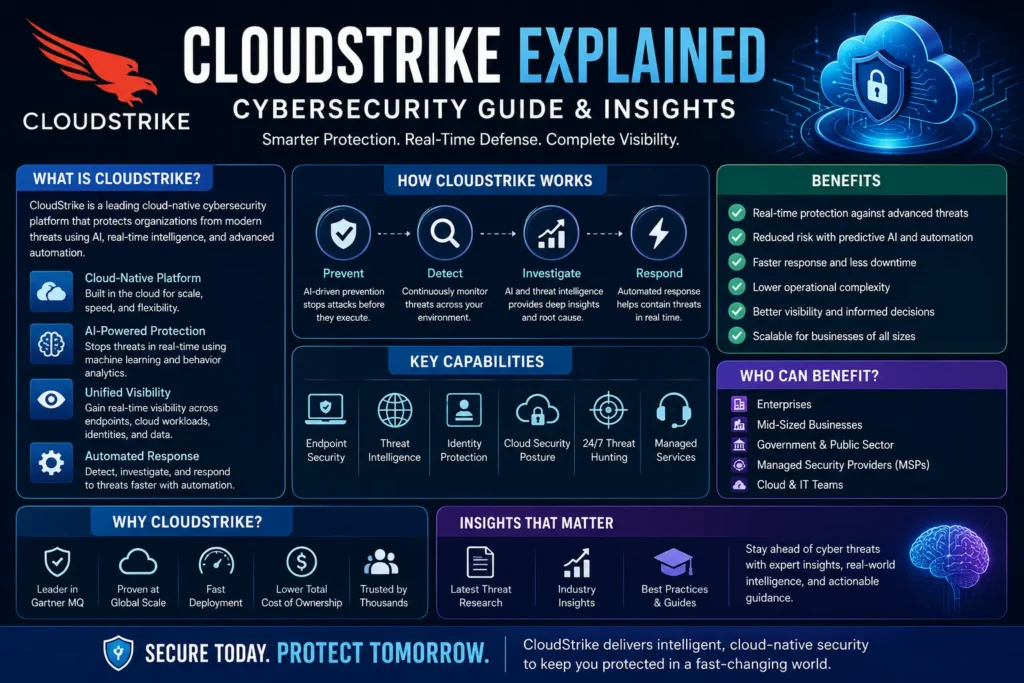
In today’s rapidly evolving digital landscape, CloudStrike has become a frequently searched term in discussions around modern cybersecurity and cloud-based protection systems. As businesses increasingly shift their operations to cloud environments, the need for strong cloud security and advanced cybersecurity solutions has never been more critical. Organizations now rely on intelligent defense systems that can detect, prevent, and respond to threats in real time, especially as cyberattacks grow more sophisticated and targeted.
At the same time, the term CloudStrike is often confused with leading platforms in the industry, particularly endpoint protection technologies and established providers like CrowdStrike. This confusion highlights a broader issue in the cybersecurity space: many users search for cloud-based defense tools without fully understanding the differences between brands, concepts, and technologies. To make informed decisions, it is essential to understand how cloud security platforms, threat detection systems, and modern endpoint detection and response (EDR) solutions actually work in protecting digital infrastructure.
What Is CloudStrike?
CloudStrike is a term commonly used in online searches to describe modern cloud-based cybersecurity concepts, although it is not always tied to a single officially defined product or vendor. In most contexts, it refers to the idea of a cloud security platform that is designed to protect digital environments by monitoring, detecting, and responding to threats across distributed systems. These systems operate by analyzing data in real time and helping organizations defend against increasingly complex cyber risks.
Why Cloud Security Matters Today
The importance of cloud security has grown significantly due to the sharp rise in ransomware attacks, phishing campaigns, and large-scale data breaches targeting organizations of all sizes. Cybercriminals are now using more advanced techniques to exploit vulnerabilities in cloud environments, making traditional security models less effective. This is where cloud security platforms and cybersecurity solutions become essential, as they provide real-time monitoring and automated defense mechanisms to identify and stop threats before they spread.
Another major factor driving the need for stronger protection is the global shift toward remote work environments. With employees accessing company systems from multiple devices and locations, the attack surface has expanded dramatically. This has increased demand for robust endpoint protection systems that can secure every connected device, regardless of location. As a result, modern organizations rely heavily on integrated cloud-based security tools to maintain visibility, control, and resilience across their entire digital infrastructure.
Is CloudStrike the Same as CrowdStrike?
CloudStrike is often confused with CrowdStrike due to the similarity in naming, but in reality, they are not the same. Many users searching for cybersecurity vendor solutions or modern endpoint detection and response (EDR) platforms mistakenly assume both terms refer to the same product or company. This confusion usually happens because “CloudStrike” is commonly used as a search variation or misspelling when people are actually trying to find information about established cybersecurity providers.CloudStrike is not a recognized standalone enterprise solution, while CrowdStrike is a well-established leader in the cybersecurity industry. Understanding this distinction is important for anyone researching CrowdStrike Falcon or other enterprise-grade security tools.
Overview of CrowdStrike as a Leading Cybersecurity Company
CrowdStrike is a globally recognized cybersecurity vendor known for its cloud-native security platform, CrowdStrike Falcon. It specializes in protecting organizations from advanced threats through artificial intelligence, behavioral analytics, and real-time threat intelligence. Its core focus is on delivering scalable protection across endpoints, workloads, and identities in cloud environments.
The platform is widely used for endpoint detection and response (EDR), helping security teams identify, investigate, and respond to threats quickly. By leveraging cloud-based architecture, CrowdStrike eliminates the need for heavy on-premise infrastructure while providing continuous monitoring and rapid threat mitigation across enterprise systems.
Key Differences and Naming Confusion
The primary difference between CloudStrike and CrowdStrike lies in legitimacy and industry presence. CrowdStrike is a real, publicly recognized cybersecurity company, while CloudStrike is often a misinterpretation or informal variation used in search queries related to cloud security tools and services.
This naming confusion is further amplified by SEO patterns and user behavior, where people searching for CrowdStrike Falcon or endpoint detection and response (EDR) systems may accidentally type “CloudStrike.” As a result, search engines sometimes group these terms, even though only CrowdStrike represents an actual enterprise-grade cybersecurity platform.
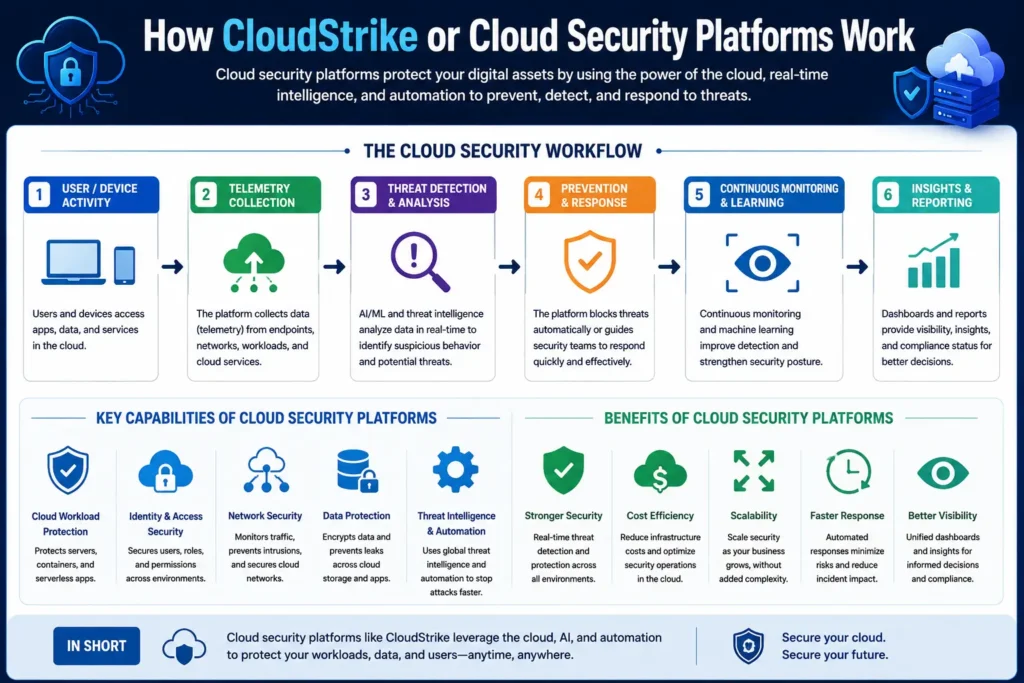
How CloudStrike or Cloud Security Platforms Work
CloudStrike and modern cloud security platforms operate by combining intelligent monitoring systems, artificial intelligence, and automated response mechanisms to protect digital environments from evolving cyber threats. These systems are designed to continuously analyze large volumes of data generated across networks, devices, and applications, ensuring that suspicious activity is detected early. In most cases, they rely on AI-based analysis and endpoint monitoring systems to identify abnormal behavior patterns and prevent potential breaches before they escalate. This makes CloudStrike-style systems highly effective in modern environments where speed and accuracy are critical for preventing data loss and system compromise.
Core Security Architecture
Cloud security platforms are built on a layered architecture that integrates cloud infrastructure, endpoint agents, and advanced analytics to ensure full visibility across an organization’s digital ecosystem. This structure enables continuous communication between devices and centralized cloud servers, where data is processed and analyzed in real time. The goal is to maintain constant protection while minimizing performance impact on individual devices.
These systems rely heavily on behavioral intelligence and machine learning models to detect threats that traditional antivirus tools might miss. By analyzing patterns of activity rather than just known signatures, they can identify previously unknown attacks and respond proactively. This architectural approach is what makes CloudStrike-type platforms highly scalable and adaptable to modern cybersecurity challenges.
- Cloud servers — Centralized infrastructure that collects and processes security data from all connected devices, enabling fast analysis and coordinated threat detection.
- Agent-based endpoint protection — Lightweight software installed on devices that continuously monitors system activity and sends data to the cloud for analysis.
- Behavioral analytics — An advanced detection method that studies user and system behavior patterns to identify unusual or potentially malicious actions before damage occurs.
Key Features of Cloud Security Platforms
CloudStrike and modern cloud security platforms are built with a wide range of advanced capabilities designed to protect organizations from increasingly complex cyber threats. These systems combine automation, intelligence, and continuous monitoring to ensure that attacks are detected and stopped in real time. Core functions such as threat detection and response, endpoint protection (EDR/XDR), AI-driven analytics, real-time monitoring, and zero-trust architecture work together to create a layered defense system that strengthens overall security posture. Each feature plays a specific role in improving visibility, speed, and accuracy in threat management. Instead of relying on traditional security methods that react after an attack occurs, CloudStrike-style platforms focus on proactive defense.
Advanced Threat Intelligence
Advanced threat intelligence is a critical component of modern cloud security platforms, enabling systems to identify, analyze, and respond to threats using both historical and real-time data. It enhances the effectiveness of machine learning detection models by continuously feeding them updated threat patterns and attack signatures. This allows platforms to recognize even previously unseen threats and respond with higher accuracy.
Another important element is the use of a global threat database, which aggregates intelligence from millions of endpoints worldwide. This shared data ecosystem helps CloudStrike-type systems stay ahead of emerging cyber threats by learning from attacks happening across different industries and regions. As a result, organizations benefit from faster detection and more informed security decisions.
- Threat detection and response — Continuously identifies suspicious activities and automatically responds to potential threats before they can cause damage.
- Endpoint protection (EDR/XDR) — Secures individual devices and extends visibility across entire networks, enabling faster investigation and response to incidents.
- AI-driven analytics — Uses artificial intelligence to analyze large volumes of data and detect hidden or complex threat patterns.
- Real-time monitoring — Provides continuous surveillance of systems and networks to instantly detect abnormal behavior or unauthorized access attempts.
- Zero-trust architecture —A security model that requires verification for every user and device, reducing the risk of internal and external breaches.
Benefits of Cloud-Based Security Systems
CloudStrike and modern cloud-based security systems provide organizations with scalable, intelligent, and highly responsive protection against evolving cyber threats in today’s digital environment. These systems reduce infrastructure complexity while improving detection speed, operational efficiency, and overall security visibility across cloud and hybrid networks. By leveraging automation and advanced analytics, they enable businesses to prevent attacks proactively, ensure continuous monitoring, and maintain strong protection without relying on traditional hardware-heavy security models.
Benefits of Cloud-Based
- Scalable protection that adapts easily to growing business infrastructure and increasing digital workloads efficiently.
- Faster threat detection using AI-driven systems that identify suspicious activities in real time across networks.
- Reduced infrastructure costs by eliminating the need for expensive on-premise security hardware and maintenance.
- Continuous monitoring of all endpoints, ensuring constant visibility into system activity and potential vulnerabilities.
- Real-time alerts that notify security teams immediately when unusual or malicious behavior is detected.
- Remote security coverage enabling protection for employees working from multiple global locations and devices.
- Automated threat response that quickly isolates infected systems to prevent widespread damage or data loss.
- Centralized security management allows organizations to control all security operations from a single cloud dashboard.
- Improved compliance support helps businesses meet industry security standards and regulatory requirements efficiently.
- Enhanced threat intelligence integration that continuously updates defenses using global cybersecurity data sources.
CloudStrike vs Competitors
CloudStrike is often discussed in the context of modern cloud cybersecurity platforms, but it is also frequently compared with established industry leaders such as CrowdStrike, SentinelOne, and Microsoft Defender for Endpoint. These comparisons typically focus on capabilities like threat detection, endpoint protection, artificial intelligence integration, and overall ease of deployment. While CloudStrike is commonly used as a conceptual or search-based term for cloud security solutions, its competitors represent fully developed cybersecurity vendors with mature enterprise-grade platforms. Understanding these differences helps organizations evaluate which solution best fits their security needs and infrastructure requirements.
| Platform | Strength | Focus Area | Key Technology | Deployment Model |
| CloudStrike | Conceptual cloud security reference | General cloud security understanding | AI-based security concepts | Not a standalone vendor |
| CrowdStrike Falcon | Advanced threat intelligence | Enterprise endpoint protection | AI + behavioral analytics | Cloud-native SaaS |
| SentinelOne | Autonomous cybersecurity response | Endpoint security automation | Machine learning + AI response | Cloud-managed platform |
| Microsoft Defender for Endpoint | Strong OS integration | Windows ecosystem security | Native Microsoft security stack | Hybrid cloud-integrated |
Common Misconceptions About CloudStrike
CloudStrike is frequently misunderstood in the cybersecurity space, largely due to naming similarities with well-known security vendors and the general complexity of cloud-based protection technologies. Many users searching for cybersecurity vendor solutions or endpoint detection and response (EDR) platforms assume that CloudStrike is a standalone product or a direct competitor to established companies. In reality, most of this confusion comes from search behavior, informal terminology, and overlapping concepts in cloud security discussions. This misunderstanding often leads to incorrect assumptions about its capabilities, structure, and market presence. While CloudStrike is commonly used as a reference term for cloud security platforms, it does not always represent a formal enterprise cybersecurity solution.
CloudStrike vs CrowdStrike Confusion
One of the most common misconceptions is the belief that CloudStrike and CrowdStrike are the same or directly related. This confusion is amplified by the similarity in names and the frequent association with CrowdStrike Falcon, a leading cybersecurity vendor platform. As a result, many users mistakenly use “CloudStrike” when searching for CrowdStrike’s endpoint protection and threat intelligence services.
In reality, CrowdStrike is a well-established company offering advanced endpoint detection and response (EDR) solutions, while CloudStrike is not a distinct enterprise product. The overlap exists primarily in search behavior and terminology, not in actual product offerings or corporate identity.
Misunderstanding as a Standalone Product
Another major misconception is that CloudStrike functions as a fully developed cybersecurity platform similar to enterprise tools. Many assume it offers built-in cloud security platform capabilities, including monitoring, threat response, and endpoint protection features. However, this assumption is largely based on how the term is used in online discussions rather than on an official product structure.
In practice, CloudStrike is better understood as a generalized or conceptual term rather than a standalone cybersecurity solution. It is often used interchangeably in search queries related to cloud security technologies, which leads to further confusion among users trying to evaluate real security tools.
Branding Ambiguity in Search Results
Search engines often contribute to confusion around CloudStrike by grouping it with similar cybersecurity-related keywords and platforms. This creates ambiguity, especially when users are looking for information on cloud security platforms or enterprise-grade protection tools. As a result, CloudStrike may appear alongside legitimate vendors, even though it does not represent a separate commercial product.
This branding ambiguity is further reinforced by SEO patterns and user-generated content, where CloudStrike is used informally to describe cloud-based security systems. Over time, this has blurred the distinction between actual cybersecurity companies and general terminology used to describe the industry.
Future of Cloud Security
The future of CloudStrike and modern cloud security systems is expected to evolve rapidly as cyber threats become more advanced, automated, and difficult to detect. Organizations will increasingly depend on intelligent cloud security platforms that integrate AI, automation, and real-time analytics to defend against sophisticated attacks. As digital transformation accelerates, security models will shift toward predictive protection, stronger identity verification, and fully automated cybersecurity solutions that reduce human intervention and improve response speed.
- AI-driven threat prediction enables systems to detect attacks before they fully develop or cause damage.
- Expansion of zero-trust architecture, enforcing strict verification for every user, device, and network request continuously.
- Increased automation in incident response reduces manual intervention and improves reaction time against cyber threats.
- Integration of advanced machine learning models improves the accuracy of malware and anomaly detection across systems.
- The growth of cloud-native security platforms is replacing traditional on-premise infrastructure with scalable digital solutions.
- Enhanced endpoint protection covering remote devices used in hybrid and fully distributed work environments globally.
- Greater use of behavioral analytics to identify unusual user activity patterns to prevent unauthorized access attempts.
- Stronger global threat intelligence sharing is improving collective defense against emerging cyberattack techniques worldwide.
- Expansion of identity-based security systems focusing on verifying users rather than just devices or networks.
- Continuous evolution of cybersecurity frameworks, adapting to new digital risks and sophisticated attack methods.
Frequently Asked Questions
What is CloudStrike?
CloudStrike is generally used as a search term related to cybersecurity solutions and cloud-based protection systems, but it is not a standalone major cybersecurity product or vendor.
Is CloudStrike a real cybersecurity company?
No, CloudStrike is not recognized as an independent cybersecurity vendor. It is often used informally or mistakenly when referring to cloud security technologies.
Is CloudStrike the same as CrowdStrike?
No, CloudStrike is frequently confused with CrowdStrike Falcon, a leading endpoint detection and response (EDR) platform, but they are not the same.
Why do people search for CloudStrike?
Users often search for CloudStrike when looking for cloud security platforms or modern cybersecurity tools, leading to common naming confusion.
What is the difference between CloudStrike and cloud security platforms?
CloudStrike is a conceptual or mistaken term, while cloud security platforms are real systems that protect data, endpoints, and networks using cloud-based infrastructure.
Conclusion
CloudStrike is widely used as a search term in the cybersecurity space, but it is best understood as a conceptual reference rather than a standalone cloud security platform. Throughout this article, we explored how it is often linked with modern cybersecurity solutions and confused with established technologies such as endpoint protection systems and enterprise-grade security vendors.
In reality, the confusion around CloudStrike highlights how complex and rapidly evolving the cybersecurity industry has become. As organizations continue adopting cloud-based infrastructure, the demand for reliable cloud security platforms and advanced endpoint detection and response (EDR) systems will only increase. Understanding these distinctions helps businesses and users make more informed decisions when evaluating real cybersecurity tools and protecting their digital environments.